
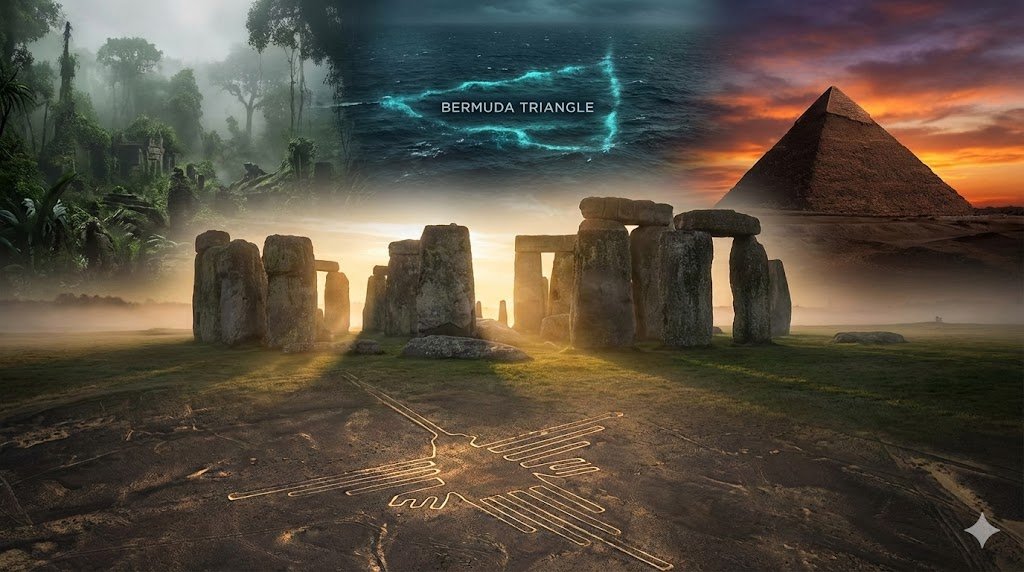
Despite centuries of scientific progress and advanced technology, our planet still hides places that challenge logic, science, and human understanding. From ancient structures to unexplained natural phenomena, these mysterious locations continue to puzzle researchers and spark global curiosity.
Here are seven of the most mysterious places on Earth that scientists still can’t fully explain.
1. The Bermuda Triangle (Atlantic Ocean)
The Bermuda Triangle is one of the world’s most famous unsolved mysteries. Located between Florida, Bermuda, and Puerto Rico, this region has been linked to the unexplained disappearance of ships and aircraft.
Scientists have proposed theories ranging from magnetic anomalies to extreme weather patterns, yet no single explanation accounts for every incident. Despite modern navigation systems, the mystery of the Bermuda Triangle remains unresolved.
2. Stonehenge (England)
Stonehenge is a prehistoric monument made of massive stone blocks weighing up to 25 tons each. What baffles scientists is how ancient humans transported and arranged these stones with such precision over 4,000 years ago.
Even more mysterious is its purpose. Was it a religious site, an astronomical calendar, or a healing center? While many theories exist, definitive answers remain out of reach.
3. The Nazca Lines (Peru)
Carved into the desert floor of southern Peru, the Nazca Lines are enormous geoglyphs depicting animals, plants, and geometric shapes. These designs are best viewed from the air, raising a critical question: why were they created in a way ancient people couldn’t easily see?
Despite extensive research, scientists still debate whether these lines were used for religious rituals, astronomical observations, or something else entirely.
4. Easter Island Statues (Chile)
Easter Island is home to nearly 1,000 massive stone statues known as Moai. Each statue weighs several tons, yet the island lacked advanced tools or machinery.
The biggest mystery isn’t just how they were carved, but how they were transported across the island. Some researchers suggest the statues were “walked” upright, but the method has never been conclusively proven.
5. The Great Pyramid of Giza (Egypt)
The Great Pyramid is one of the most studied structures in human history—and still one of the least understood. Built over 4,500 years ago, its precise alignment with the cardinal directions continues to amaze engineers.
Even today, scientists debate how the massive limestone blocks were moved and assembled with such accuracy. Recent discoveries of hidden chambers have added new layers to this ancient mystery.
6. Lake Hillier (Australia)
Lake Hillier is famous for its striking pink color, which remains vibrant year-round. While scientists believe microorganisms may be responsible, no single explanation has been confirmed.
What makes this lake even more mysterious is that its pink color doesn’t fade when water is removed, defying normal expectations of natural pigmentation.
7. The Devil’s Kettle Waterfall (USA)
Located in Minnesota, the Devil’s Kettle Waterfall features a strange hole where half of the river appears to vanish underground. For years, scientists couldn’t determine where the water went.
Although modern experiments suggest it rejoins the river downstream, the underground path remains uncharted, leaving unanswered questions about the waterfall’s true behavior.